How a wing makes lift
⏱ 15 min
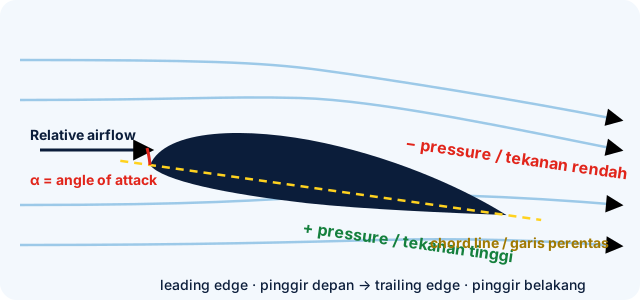
A wing has a special cross-section called an aerofoil: rounded leading edge, curved (cambered) upper surface and a sharp trailing edge. The straight line from leading edge to trailing edge is the chord line. The angle between the chord line and the oncoming air (relative airflow) is the angle of attack.
As air flows around the wing it is turned downwards. Air over the curved top speeds up and its pressure falls (Bernoulli), while air below is slowed slightly and pressure rises. The pressure difference and the downward-turned air (Newton's third law) together give lift.
The lift formula
L = ½ ρ V² S CL — lift depends on air density (ρ), the square of airspeed (V²), wing area (S) and the lift coefficient (CL), which grows with angle of attack. Double the speed and you get four times the lift!
The stall
Lift increases with angle of attack only up to the critical angle (around 15–18° for a typical light aircraft wing). Beyond it, the airflow separates from the upper surface, lift suddenly drops and the aircraft stalls. A stall is about angle of attack — it can happen at any speed. The cure is to lower the nose (reduce the angle of attack) and add power.
Flaps increase camber and CL, so the aircraft can fly slower for take-off and landing.